Every day, businesses invest thousands of rupees in Google Ads hoping to generate leads, sales, and revenue. Yet many campaigns end up delivering disappointing results. Some receive plenty of clicks but no enquiries, while others consume the entire budget with little to show for it.
The problem isn’t Google Ads itself. In most cases, it’s the strategy behind the campaign.
Google Ads remains one of the most effective digital marketing platforms available today. When planned and managed correctly, it allows businesses to reach customers at the exact moment they are searching for a product or service. However, success depends on much more than simply choosing a few keywords and setting a daily budget.
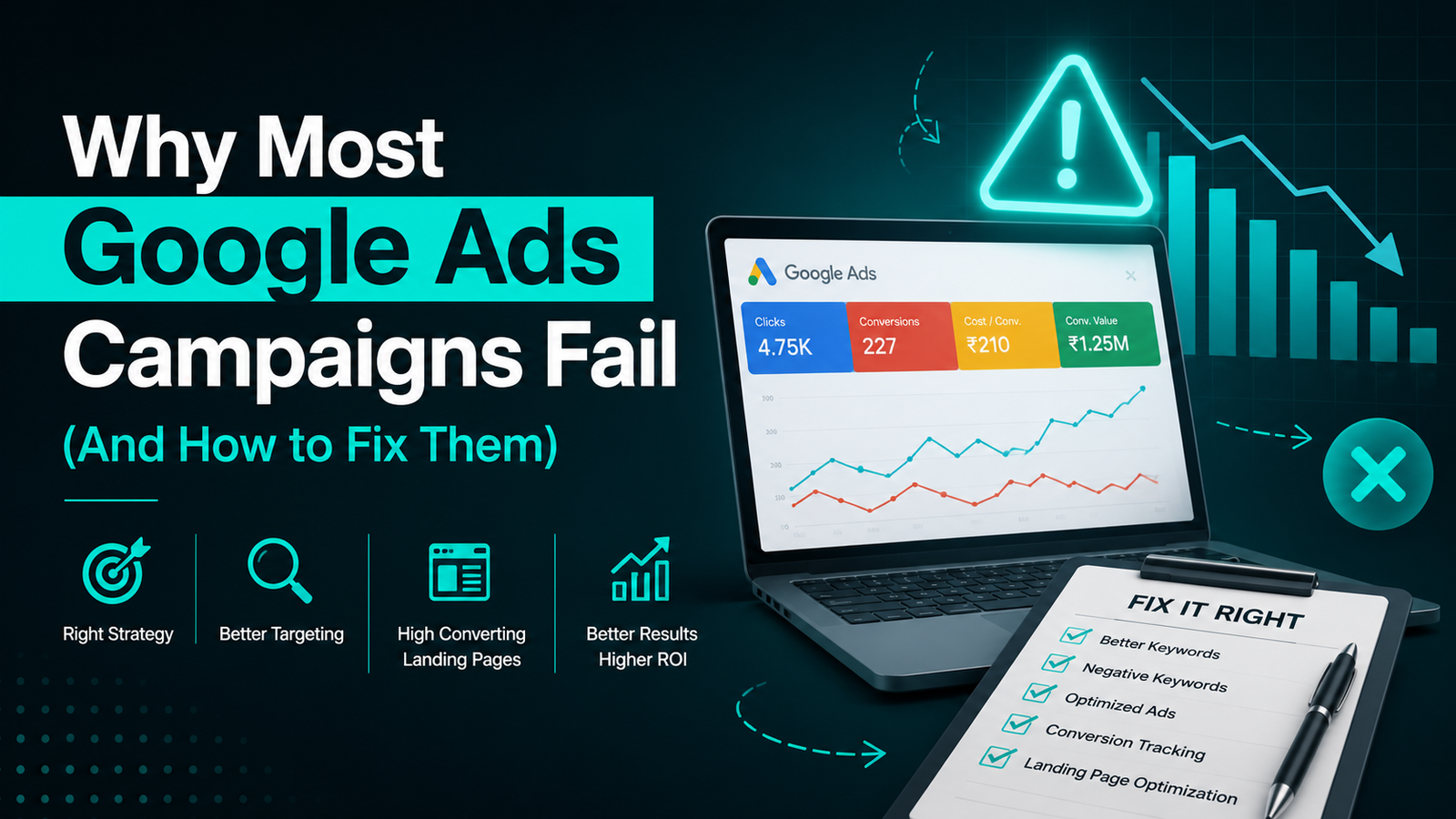
Let’s explore the most common reasons why Google Ads campaigns fail and, more importantly, how to fix them.
1. Targeting the Wrong Keywords
One of the biggest mistakes businesses make is selecting keywords based solely on search volume.
For example, a company selling premium office furniture may target a broad keyword like chairs. While it attracts many searches, it also includes people looking for gaming chairs, plastic chairs, dining chairs, repairs, or even images.
Broad keywords often bring irrelevant traffic that rarely converts.
How to Fix It
Focus on keywords with strong buying intent. These are phrases people use when they are ready to make a decision, such as:
- Office furniture supplier
- Premium office chairs near me
- Buy ergonomic office chair
- Digital marketing agency in Kolkata
- SEO services for small business
Use keyword research tools and regularly review search term reports to identify high-performing queries.
2. Ignoring Negative Keywords
Many businesses never add negative keywords to their campaigns.
As a result, Google may display ads for searches such as:
- Free
- Jobs
- Internship
- Training
- Course
- Tutorial
If you’re selling services, paying for these clicks wastes your advertising budget.
How to Fix It
Build a comprehensive negative keyword list and update it regularly.
For example, if you’re running campaigns for a marketing agency, common negatives may include:
- Free
- Salary
- Career
- Internship
- Jobs
- Course
- Certificate
This simple step often improves campaign efficiency immediately.
3. Sending Visitors to a Weak Landing Page
A common misconception is that Google Ads alone generate leads.
In reality, the landing page plays an equally important role.
Imagine someone clicks your ad only to find:
- Slow loading speed
- Confusing navigation
- Too much text
- No clear call-to-action
- Poor mobile experience
Most visitors will leave within seconds.
How to Fix It
A high-converting landing page should include:
- A clear headline
- Strong value proposition
- Trust signals such as reviews or testimonials
- Fast loading speed
- Mobile responsiveness
- A simple enquiry form
- Clear contact information
- Prominent call-to-action buttons
Remember, every click costs money. Make sure your landing page gives visitors a reason to stay.
4. Poor Audience Targeting
Showing ads to everyone rarely works.
A business targeting customers in Kolkata doesn’t need clicks from other states unless it serves those locations.
Similarly, B2B campaigns require a different strategy than B2C campaigns.
How to Fix It
Use audience targeting features such as:
- Location targeting
- Device targeting
- Demographics
- Custom audiences
- In-market audiences
- Remarketing lists
The more relevant your audience, the higher your chances of conversion.
5. Not Tracking Conversions
Many advertisers judge campaigns based on clicks alone.
Clicks don’t pay the bills.
Conversions do.
Without proper conversion tracking, it’s impossible to know:
- Which keywords generate leads
- Which ads perform best
- Which landing pages convert
- Which campaigns deserve more budget
How to Fix It
Set up conversion tracking using:
- Google Ads Conversion Tracking
- Google Analytics 4
- Enhanced Conversions
- Call Tracking
- Lead Form Tracking
Data-driven decisions always outperform assumptions.
6. Weak Ad Copy
If your advertisement looks similar to every competitor, users have little reason to click.
Generic headlines like:
- Best Services
- Affordable Solutions
- Contact Us Today
fail to stand out.
How to Fix It
Your ads should communicate:
- What makes your business different
- Benefits instead of features
- Strong calls to action
- Customer pain points
- Trust and credibility
Use all available headline and description fields to improve ad strength.
7. Expecting Results Too Quickly
Google Ads is often misunderstood as an instant solution.
While campaigns can generate traffic immediately, optimization takes time.
Successful advertisers continuously:
- Test headlines
- Adjust bids
- Improve landing pages
- Refine keywords
- Analyse user behaviour
Campaign performance improves through consistent optimisation rather than one-time setup.
8. Choosing the Wrong Campaign Type
Not every campaign objective requires the same approach.
Running a Display Campaign when your goal is immediate lead generation may produce disappointing results.
Similarly, using Performance Max without sufficient conversion data can make optimisation more challenging.
How to Fix It
Choose campaign types based on business goals:
- Search Campaigns for high-intent leads
- Performance Max for broader reach with quality conversion data
- Display Campaigns for brand awareness
- Shopping Campaigns for eCommerce
- Video Campaigns for audience engagement
Selecting the right campaign structure is just as important as selecting the right keywords.
9. Ignoring Mobile Users
Today, a significant percentage of Google searches happen on smartphones.
If your website isn’t mobile-friendly, you’re losing potential customers.
Common issues include:
- Small buttons
- Difficult forms
- Slow loading
- Broken layouts
How to Fix It
Regularly test your landing pages on multiple mobile devices.
A fast, responsive experience often leads to better Quality Scores and higher conversion rates.
10. Never Reviewing Campaign Performance
Launching a campaign and forgetting about it is one of the most expensive mistakes advertisers make.
Google Ads requires ongoing optimisation.
Weekly or monthly reviews help identify:
- High-performing keywords
- Wasted ad spend
- Low-performing locations
- Device performance
- Budget allocation opportunities
Continuous improvement is what separates average campaigns from profitable ones.
A Simple Google Ads Success Checklist
Before launching your next campaign, make sure you’ve covered the essentials:
- Define a clear business objective.
- Research high-intent keywords.
- Add relevant negative keywords.
- Create compelling ad copy.
- Build a fast, conversion-focused landing page.
- Set up conversion tracking.
- Choose the right campaign type.
- Target the correct audience.
- Monitor performance regularly.
- Optimise based on real data.
Final Thoughts
Google Ads doesn’t fail because the platform is ineffective. Most campaigns struggle because they lack planning, testing, and ongoing optimisation.
Businesses that treat Google Ads as a long-term growth channel—rather than a one-time advertising expense—often achieve better lead quality, stronger return on investment, and sustainable growth.
Whether you’re a startup looking for your first customers or an established company aiming to scale, the difference between an average campaign and a high-performing one lies in strategy, execution, and continuous improvement.
Investing in the right approach today can save significant advertising costs while generating better results in the future.